


In the dynamic world of radio-controlled aviation, the right RC Transmitter can make all the difference. Whether you’re an amateur just starting out or a seasoned flyer, the myriad options available can be overwhelming. Fortunately, with the combined expertise of our seasoned RC specialists, accumulated from years of experience and extensive market analysis, we’re here to illuminate the path.
This article aims to provide invaluable insights and recommendations, ensuring every RC Airplane and helicopter enthusiast finds the perfect transmitter that fits their unique needs.
Best Affordable Transmitter: Flysky FS-i6
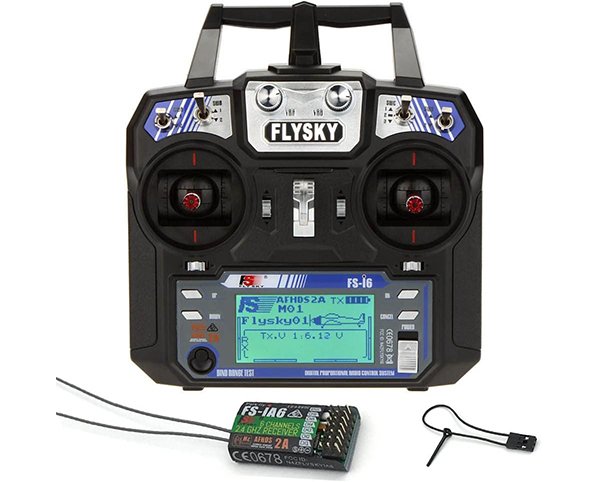
Channels: 6
RF range: 2.405-2.475GHz
Bandwidth: 500KHz
Band: 142
RF power: less than 20dBm
Sensitivity: 1024
Size:174 * 89 * 190mm
Weight: 392g
When it comes to value for money, the Flysky FS-i6 stands out prominently. What strikes me first about this transmitter is how it delivers an array of advanced features at such an affordable price point. Holding the transmitter, its compact size feels just right in hand, and the robust design means I don’t have to worry about snapping the antenna.
Having used both customizable high-end transmitters and basic ones, the FS-i6, for its price, is hard to beat. It’s the quintessential starter remote, providing everything a newbie could ask for and leaving room for expansion as one delves deeper into the hobby. The 6 channels cater perfectly to beginners, offering just the right balance between functionality and simplicity.
If you’re a novice in the RC Airplane and helicopter world, splurging on a pricier transmitter right off the bat might not be the wisest move. The FS-i6 offers an ideal bridge; start with it, and once you’ve outgrown the beginner phase, move on to something more performance-driven.
One of the aspects I genuinely appreciate is its user-friendly interface. Pairing receivers to the transmitter was a breeze, eliminating the typical hassles often encountered by beginners.
Best Value Transmitter: Radiolink AT10II
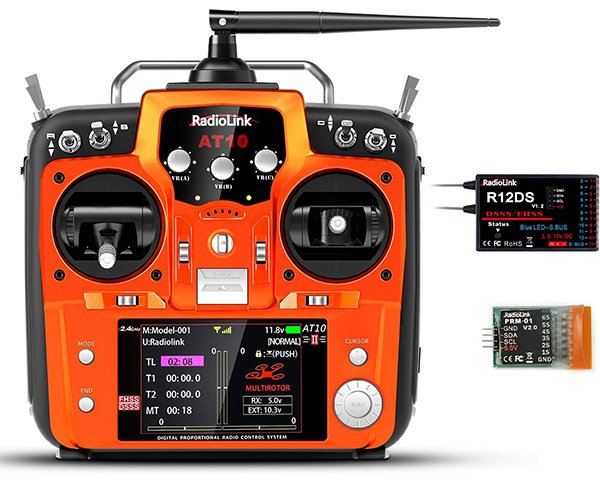
Brand: Radiolink
Channels: 12
Range: Up to 4 kilometers
Power: 7.4 Volts, Uses 8 AA batteries or 2s-4s LiPo battery
Anti-interference: DSSS&FHSS
Compatibility: Works with various receivers and models
Interface: 3.5-inch color display
Scouring the market for a transmitter that packs both features and value? Your quest might just end with the Radiolink AT10II. One of the first things that caught my eye with this transmitter is the sheer fact that it comes from a brand renowned for its impeccable customer service. Trust me, in RC airplanes and helicopters, that speaks volumes.
At its price point, the AT10II stands tall, making competing brands in the same tier pale in comparison. The 12-channel system it boasts isn’t just a number; it’s a realm of functionalities. This makes it a delight for seasoned RC hobbyists who understand the nitty-gritty of aviation electronics. The potential for intricate programming is vast, allowing for some truly remarkable aerial maneuvers.
Flying with the AT10II gives a feel that’s as smooth as silk. The gimbal operation in-flight rivals any I’ve experienced – stable, fluid, and hyper-responsive. It’s hard not to be taken aback by how seamlessly it responds, especially given its price tag.
The 3.5-inch color display is another commendable feature, ensuring ease of programming and adjustments. But what truly seals the deal is the versatility in battery options and compatibility with a plethora of receivers and models.
Best Performance Transmitter: FrSky Tandem X20S
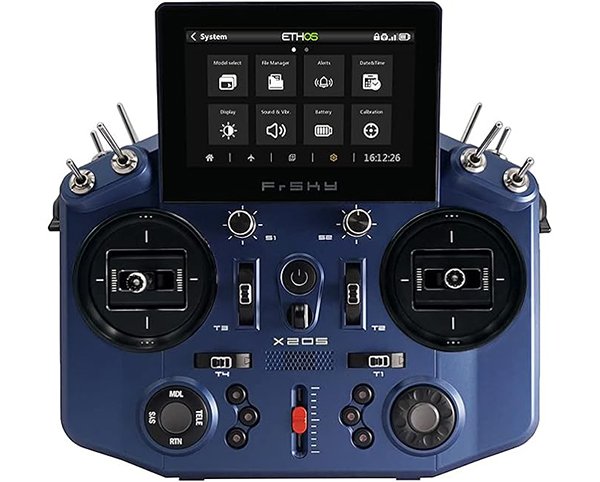
Dual-Band RF Module: Supports multiple modes
Performance: Low latency with long-range control
Display: 800*480 color touch-screen.
Alerts: Haptic vibration, etc
Gimbals: High-precision CNC Hall-Sensor gimbals
Dual-Band System: 900MHz and 2.4GHz
Among the high-performing transmitters for RC airplanes and helicopters, the FrSky Tandem X20S stands in a league of its own. Having had the privilege of testing numerous transmitters over the years, few, if any, match the sheer excellence that the X20S brings to the table.
From the get-go, its aesthetics and ergonomic design make an impression. When you hold it, the weight, the feel, the texture – it all screams quality. But as we all know, it’s the internals and the performance that truly matter, and oh boy, does the X20S deliver!
The dual-band RF module is a game-changer. Offering both 900MHz and 2.4GHz, it ensures that interference is the least of your worries. This level of frequency diversity, combined with low latency, ensures that you remain in control, be it in close proximity or at significant distances.
Its rich feature set, as vast as an ocean, gives seasoned pilots the flexibility they often crave. From the vibrantly clear 800*480 color touch-screen display to the CNC Hall-Sensor gimbals that capture even the minutest of movements with impeccable precision, it’s evident that FrSky didn’t cut any corners.
One of its strongest assets is its intuitive programming. While many transmitters in the market bog you down with complex interfaces, the X20S’s design philosophy seems to be simplicity combined with capability. It respects both the rookie trying to find his way and the veteran seeking advanced features.
What truly stands out for me is its integration with FrSky receivers. Their superiority in dual redundant battery inputs and stabilization features is unmatched. The voice speech outputs and haptic vibration alerts add an additional layer of security, ensuring you’re always in the loop about your model’s status.
Best Smart Transmitter: Spektrum iX14
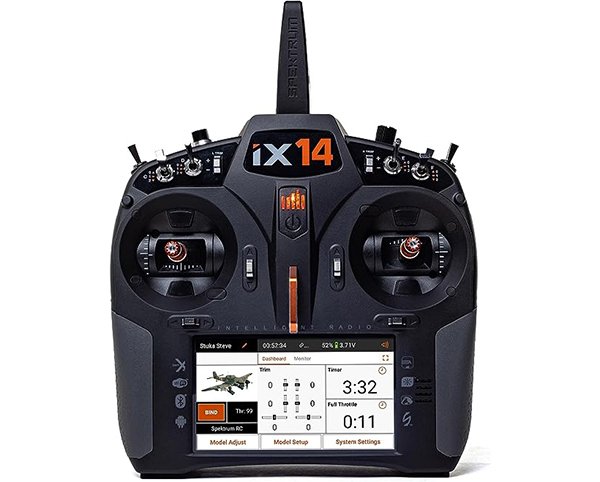
Channels: 14 channels with 22ms
Interface: Fast Android-powered touchscreen
Display: Full-color, easy-to-read screen
Gimbals: Smooth, precision Hall-effect gimbals
Speech Functionality: Speech-to-text through wired headsets
Model Memory: Up to 250 models
Smart Beyond Measure: The term ‘smart’ is thrown around a lot these days, but the iX14 truly lives up to this title. Its Android-powered interface is not only swift but intuitively designed, ensuring that both newcomers and veterans can navigate with ease. And with its vibrant, full-color display, every piece of information is just a glance away, presented with crystal clarity.
Precision at Your Fingertips: The iX14’s Hall-effect gimbals are in a league of their own. The precision they offer is simply unparalleled. Whether you’re delicately maneuvering a glider or pulling aggressive stunts with a jet, the transmitter responds with an uncanny sense of confidence and predictability. The feedback is tactile, smooth, and devoid of any jittery behaviors – a true testament to Spektrum’s engineering prowess.
Convenient Voice Commands: Incorporating speech-to-text functionality, the iX14 introduces a new dimension to user interaction. Whether you want to adjust settings or receive real-time telemetry feedback, simply relay your commands verbally through a wired headset. This adds an extra layer of safety and convenience, allowing pilots to stay locked into their flights without diverting attention.
A Library in Your Hands: With storage for up to 250 models, managing your RC fleet has never been easier. Switching between models is a breeze, and with Spektrum’s renowned reliability, you can be assured that every model will respond with the correct settings.
The intelligent iX14 can give you convenience and safety in flying an RC airplane or helicopter.
Best Open-source Transmitter: RadioMaster TX16S
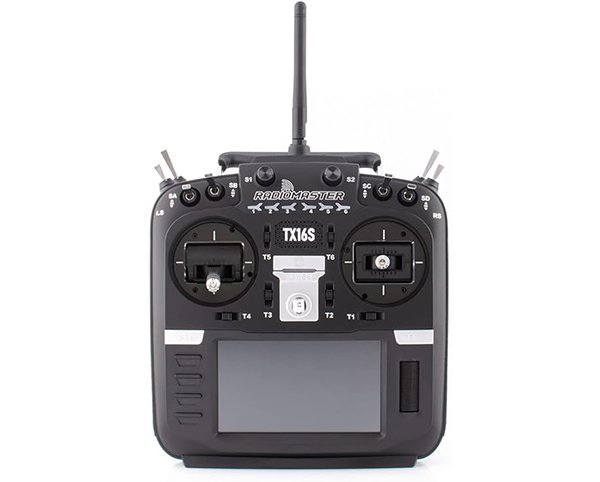
Channels: Up to 16
Size: 287x129x184mm
Weight: 750g (without battery)
Transmission Frequency: 2.400GHz-2.480GHz
Control Distance: > 2km @ 22dbm
Module: Multiprotocol-Module(4IN1) or ExpressLRS(ELRS)
Display: 4.3-inch TFT color touchscreen
In the realm of RC airplane and helicopter transmitters, while many brands jostle for the spotlight, there are a select few that genuinely push boundaries. The RadioMaster TX16S is undeniably one of them, and here’s my in-depth review.
The Power of Open-source: Right off the bat, the TX16S’s embrace of open-source solutions like EdgeTX showcases its commitment to flexibility and user adaptability. Open-source platforms encourage community-driven innovations, ensuring the transmitter remains at the cutting edge and constantly evolves with the community’s needs.
Simplified Programming: The large 4.3-inch TFT touchscreen doesn’t just look good; it revolutionizes the programming experience. No more fumbling with cumbersome buttons or scroll wheels. Now, you have an intuitive touch interface, making complex setups and tweaks a walk in the park.
Build & Performance: In hand, the TX16S feels robust and well-crafted. In-flight, it’s dependable. Throughout my testing, it demonstrated unwavering stability, even at distances exceeding 2km. This reliability is what pilots, novice or expert, truly seek.
Unparalleled Compatibility: Perhaps the TX16S’s crown jewel is its versatility. With its multiprotocol module, this transmitter can converse with an impressive array of receivers from brands like Futaba, Spektrum, and FrSky. This broad compatibility means you’re not locked into one ecosystem. Instead, you have the freedom to explore, experiment, and find the best fit for your specific needs.
Community-Backed Excellence: A quick search online, and you’re inundated with glowing endorsements, tutorials, and videos showcasing the TX16S’s prowess. The strong online community ensures that newcomers are never left in the dark and that there’s a wealth of knowledge to tap into.
Transmitter Buying Guide: RC Airplane & Helicopter
Metal Gimbal vs Plastic Gimbal
Durability and Strength: Metal gimbal known for their durability and strength. They can withstand high levels of stress and are less likely to break or wear out over time. Plastic Gimbal are generally less durable and may be more prone to breakage, especially under high torque or stress.
Precision and Smoothness: Metal Gimbal Joints offer precise and smooth movement, which is crucial for accurate control in RC applications. Plastic Gimbal may exhibit more play or slop, leading to less precise control.
Cost: Metal gimbal tend to be more expensive due to their durability and precision engineering. Plastic gimbals are generally more affordable, making them a cost-effective option for hobbyists on a budget.
How Many Channels Should I Choose?
For more complex RC models, you may require 8 to 12 channels, depending on your needs and skill level. Beginners can typically start with a 4 to 6-channel remote control system. As you gain experience and the complexity of your models increases, you can consider upgrading to a system with more channels to meet your requirements. The key is to ensure that you can effectively master and operate your remote control system to ensure safe and enjoyable flying.
Four Transmission Technologies for RC Airplane & Helicopter
Ultra-Low Latency Communication
The heart of an RC transmitter lies in its ability to provide ultra-low latency communication. This technology ensures that there is minimal delay between the operator’s input and the model’s response. It is a critical feature for applications like FPV flying and high-speed racing drones, where split-second reactions are crucial.
Frequency-Hopping Technology for Interference Resistance
To combat interference in crowded radio frequency environments, RC transmitters make use of frequency-hopping technology. This technique involves continuous switching between different frequencies during data transmission, effectively mitigating potential disruptions caused by other wireless devices or interference sources. The transmitter intelligently detects and avoids occupied frequencies, guaranteeing a stable and interference-resistant connection.
Extended Control Range with High-Power and High-Gain
For applications that demand extended control ranges, such as remote-controlled airplanes, boats, or long-range drones, RC transmitters incorporate high-power transmitters and high-gain antennas. These components significantly increase the communication range, allowing operators to maintain control even over vast distances.
Enhanced Reliability with Wideband Technology
Modern RC transmitters often harness the power of wideband technology. This approach enables data transmission over a broader frequency spectrum, offering improved resistance to interference when compared to narrowband alternatives. Wideband technology enhances signal stability and reliability, providing RC enthusiasts with responsive, interference-free, and long-range control over their models.
Digital Screen
High-end RC transmitters often feature large, colorful touchscreen displays that provide a superior user experience. On the other hand, budget RC transmitters, designed to save costs, typically lack displays but are more suitable for beginners or those with limited budgets.
Leave a Reply