

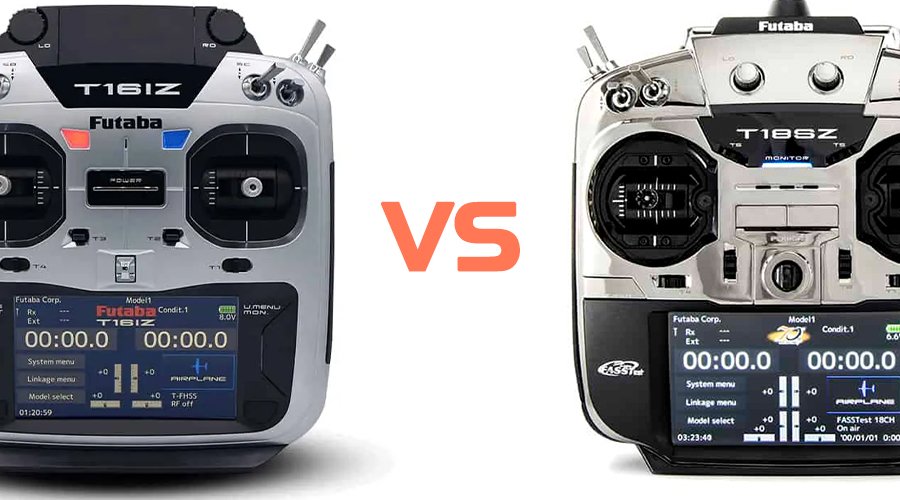
Futaba, as a front-runner in the industry, offers a wide array of transmitters tailored to various needs. Among them, the 16IZ and 18SZ stand out as top contenders for both hobbyists and professionals alike.
This article delves into a comprehensive comparison of these two models, shedding light on their unique strengths, potential areas of improvement, and their suitability for different applications. Whether you’re a seasoned pilot or just embarking on your RC journey, this guide seeks to provide clarity on which transmitter might be the best fit for you.
Detailed Base Comparison: 16IZ vs. 18SZ
Price and Affordability
The 16IZ offers a more affordable choice when compared to the 18SZ. It has been designed as a more budget-friendly alternative, making it an appealing option for those who are price-conscious.
Software Features
In terms of software, the 16IZ and 18SZ are nearly identical. However, the 16IZ comes with an extra menu option designed specifically for its 3-axis gyros. This provides users with additional flexibility and customization, especially for those who may utilize these gyro capabilities.
Gimbals
The 18SZ features fully adjustable gimbals that are identical to those in the high-end 18MZ radios. Conversely, the 16IZ uses a cheaper version, which might not offer the same level of precision or durability.
Anniversary Model
The 18SZ also has a unique Anniversary model, which boasts a distinct shiny faceplate and full aluminum gimbals, adding to its premium feel.
Transmitter Size & Switch Spacing
The 16IZ has a slimmer profile, leading to tighter switch spacing across its top two rows. This can pose a challenge for those with larger hands or fingers, potentially making it uncomfortable to use. In contrast, the 18SZ provides a more spacious layout, addressing this ergonomic issue.
Sliders & Potentiometer Controls
Users have found the sliders on the 16IZ to be inferior when compared to those on the 18SZ. This sentiment is shared with the two potentiometer controls, where the 18SZ outshines its counterpart.
Quality and Feel
Despite its lower price, some trade-offs are evident in the 16IZ’s construction. The 18SZ feels more polished and refined, whereas the 16IZ, although still a capable unit, displays signs of cost-saving measures in its features and construction.
For instance, when looking at the potentiometers, the 16IZ employs cheaper, lower-rated units, while both the 18SZ and its Anniversary version utilize higher-rated, superior-quality potentiometers. The potless version of the 18SZ, primarily available in the EU, uses Hall effect sensors instead of resistive potentiometers, signaling another quality feature in its arsenal.
Protocol Limitations
Notably, the EU version of the 16IZ lacks the capability to transmit using the FASST protocol. This limitation may be crucial for certain users or applications that rely on this specific protocol.
Conclusion: Which is Better?
Both the Futaba 16IZ and 18SZ have their merits. While the 16IZ provides an affordable option with near-identical software features, the 18SZ offers a more refined and quality experience, especially in terms of hardware and feel. Users should weigh these differences against their needs and budget before making a purchase decision.
| Feature/Specification | 16IZ | 18SZ |
| Communication System | FASSTest | FASSTest |
| Channels | 18 (16 linear + 2 switch channels) | 18 |
| Screen | HVGA 4.3 inch, full-color backlit LCD touch | HVGA 4.3 inch, full-color backlit LCD touch |
| S.Bus2 System | Yes | Yes |
| Battery Type & Capacity | 2S Lithium Polymer, 2000 mAh | 6.6 V/2,100 mAh Lithium Ferrite |
| SD Card | Yes (Optional) | Yes (Not Included) |
| Voice Telemetry | Yes | Speech Function (similar) |
| Vibration Alert | Yes | Yes |
| Operating Frequency | 2.4 GHz band | 2.4 GHz band |
| RF Power Output | 100 mW EIRP | 100mW EIRP |
| Transmitter Power Supply | 7.4 V LT2F2000B Lithium-polymer battery | 6.6 V FT2F2100BV2 LiFe battery |
Frequently Asked Questions (FAQs)
What’s the difference between FASSTest and T-FHSS?
FASSTest: This is Futaba’s top-tier telemetry communication system, allowing for bidirectional communication. With FASSTest, data from the receiver can be checked directly on the transmitter, offering real-time telemetry feedback. It’s also designed for a larger number of channels, making it suitable for more complex RC setups.
T-FHSS: T-FHSS, or T-Futaba Frequency Hopping Spread Spectrum, also provides telemetry capabilities but is typically found in mid-range Futaba transmitters. It uses a frequency-hopping spread spectrum to ensure a reliable connection with reduced interference.
What’s the purpose of the Gimbals in an RC transmitter?
Gimbals in an RC transmitter refer to the joystick-like controls that a user interacts with. They are pivotal components that translate the user’s hand movements into electronic signals, which then direct the movement and actions of the RC model
. High-quality gimbals offer better precision, smoother movement, and a more accurate response.
Is Futaba’s transmission protocol open-source?
No, Futaba’s transmission protocols, including FASST, FASSTest, and T-FHSS, are proprietary. This means they are specifically designed and owned by Futaba and are not open for public modification or redistribution. While some third-party products might be compatible with these systems, the core protocols themselves are not open-source.
Leave a Reply